Chetverikov Lab
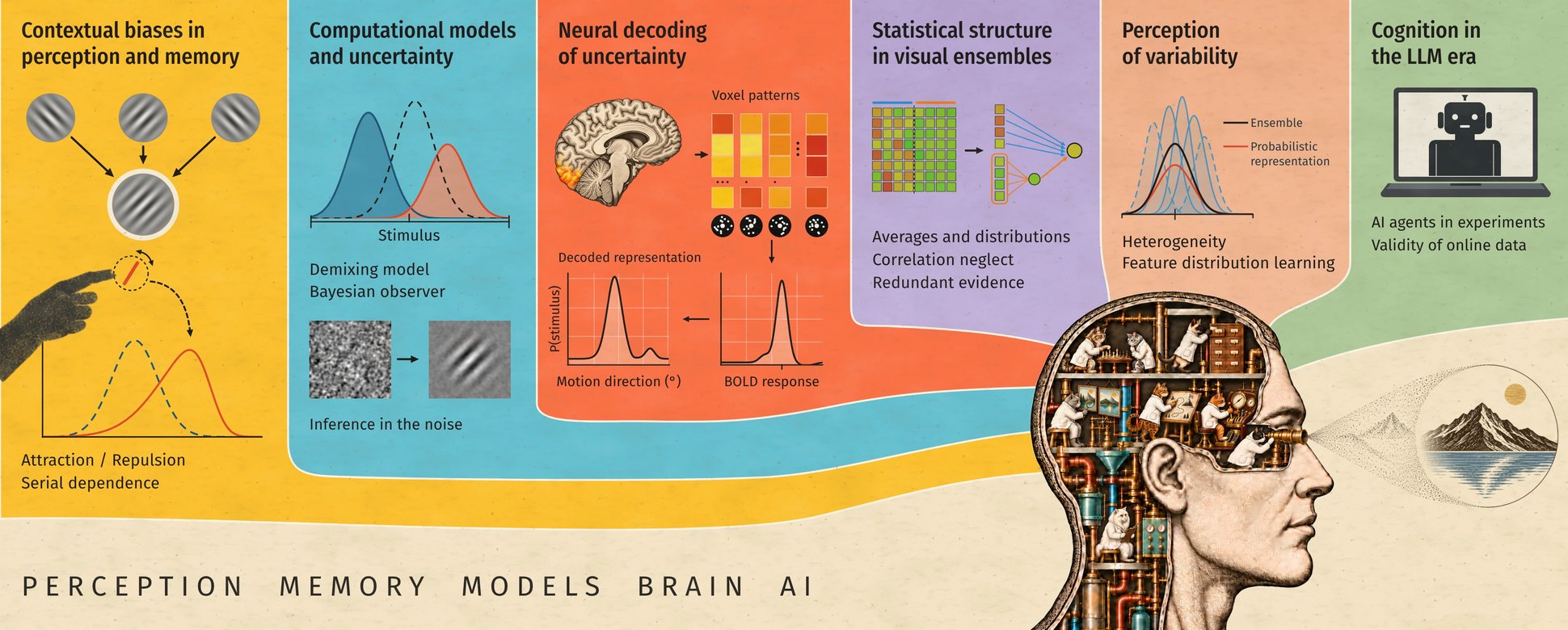
The Chetverikov Lab studies how the brain makes decisions under uncertainty, using perception and memory as a model system. We combine psychophysics, computational modeling, and neuroimaging to explain how people make robust choices despite noisy environments and noisy neural computations.
Our current main research line focuses on visual working memory: how multiple memorized items interact, how inter-item and contextual biases emerge, and how these biases can be explained with normative demixing and probabilistic models. This includes work on attraction/repulsion effects, serial dependence, and precision limits in memory-guided decisions.
Supporting lines examine external uncertainty in perception (feature distribution learning and probabilistic ensemble representations) and internal uncertainty in neural processing (model-based analyses of neuroimaging data, including Bayesian fMRI decoding).
Across these lines, the lab develops mechanistic accounts of when cognition appears fragile and when it remains robust, with applications to computational neuroscience, AI, and clinically relevant models of decision-making.

Andrey Chetverikov
Associate Professor in Cognitive Psychology
Department of Psychosocial Science, University of Bergen
Selected Publications
Noise in Competing Representations Determines the Direction of Memory Biases
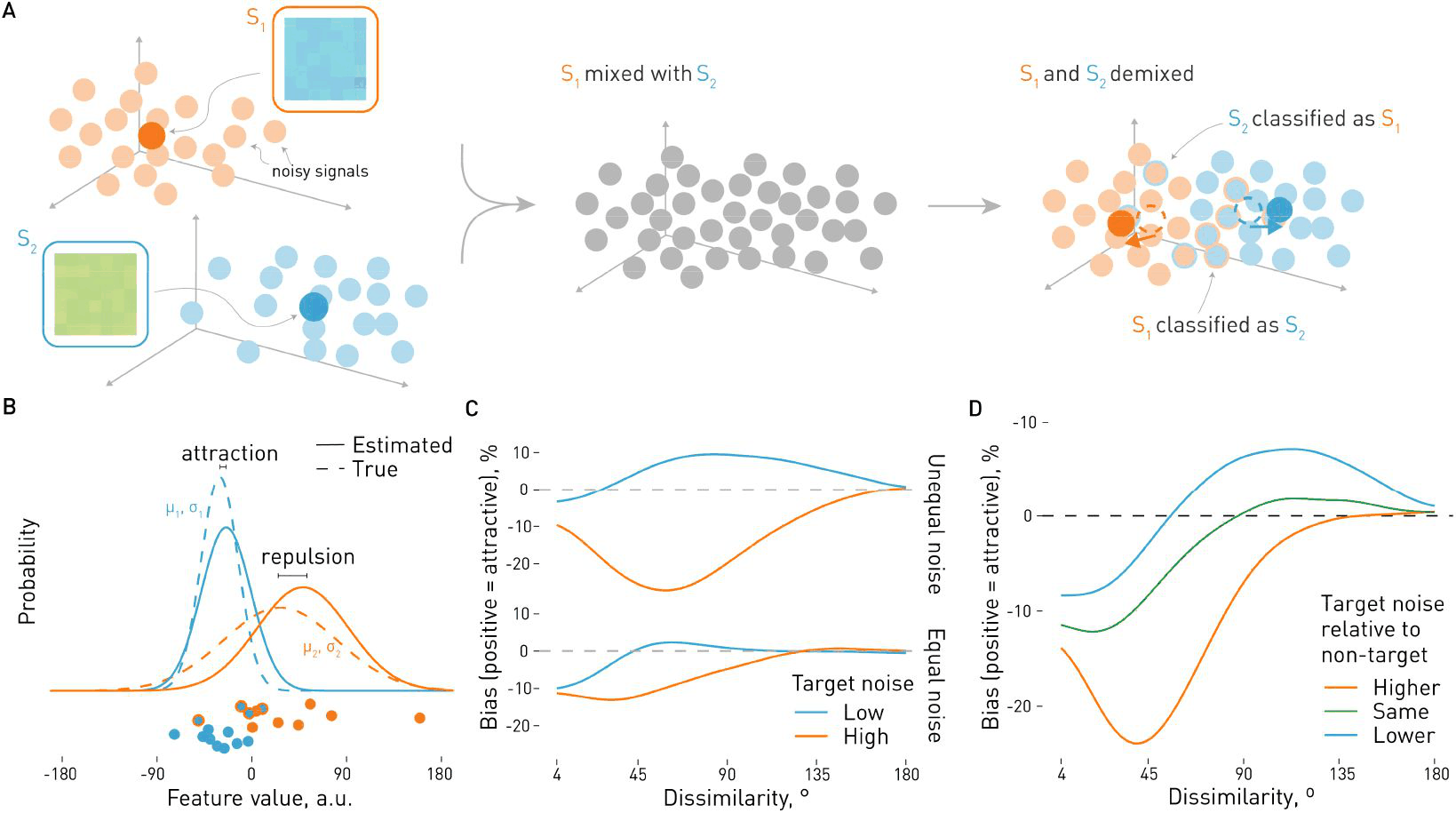
Memories are reconstructions, prone to errors. Historically considered a nuisance, memory errors have recently gained attention when found to be systematically shifted away from or toward non-reported items, promising insights into memory mechanisms. We propose that these biases are optimal and inevitable when the brain disentangles overlapping memory signals, predicting that bias direction depends on the noise distribution between memorized items, not just absolute noise levels. We tested this prediction in four color-memory experiments using novel stimuli with independently varied noise levels. The results support our hypothesis: targets with the same absolute noise level can be repelled from or attracted to non-target items, depending on their relative noise levels. We further show that the model can fit nonlinear bias patterns observed in human data with noise levels as the only free parameters. These findings challenge currently dominant models and support signal disentanglement as a unifying explanation of memory biases.
Representing Variability: How Do We Process the Heterogeneity in the Visual Environment?
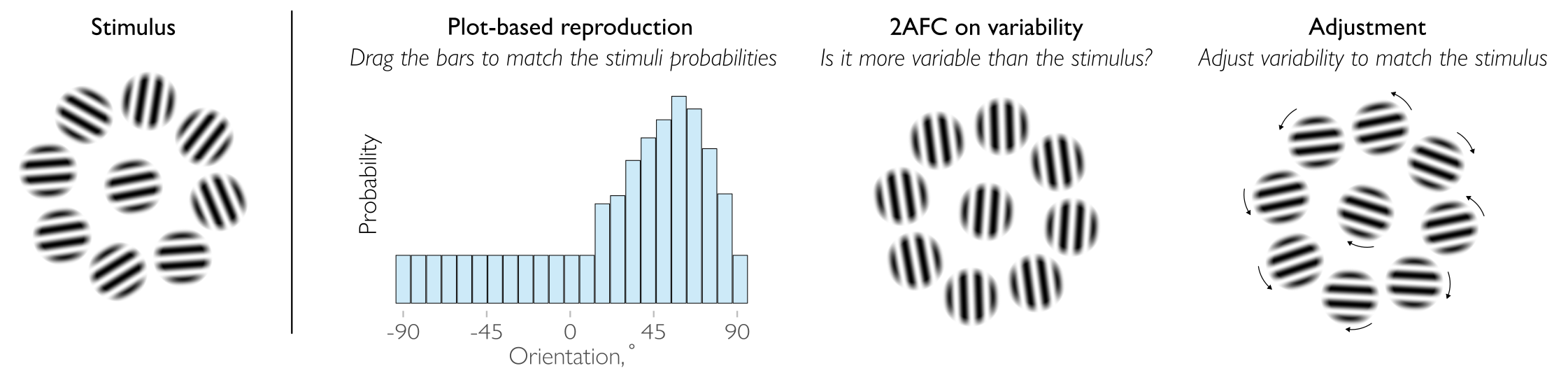
The visual world is full of detail. This Element focuses on this variability in perception, asking how it affects performance in visual tasks and how the variability is represented by human observers. The authors highlight different methods for assessing representations of variability and suggest that understanding visual variability can be elusive when straightforward explicit methods are used, while more implicit methods may be better suited to uncovering such processing. The authors conclude that variability is represented in far more detail than previously thought and that this aspect of perception is vital for understanding the complexity of visual consciousness.
Motion direction is represented as a bimodal probability distribution in the human visual cortex
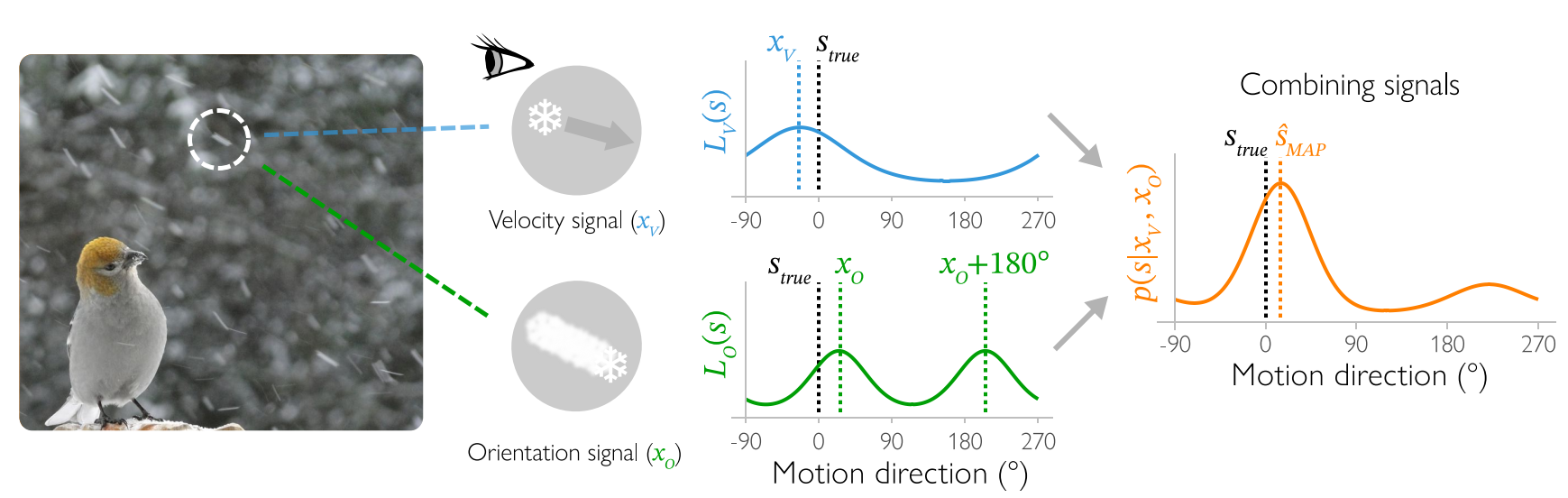
Humans infer motion direction from noisy sensory signals. We hypothesize that to make these inferences more precise, the visual system computes motion direction not only from velocity but also spatial orientation signals - a 'streak' created by moving objects. We implement this hypothesis in a Bayesian model, which quantifies knowledge with probability distributions, and test its predictions using psychophysics and fMRI. Using a probabilistic pattern-based analysis, we decode probability distributions of motion direction from trial-by-trial activity in the human visual cortex. Corroborating the predictions, the decoded distributions have a bimodal shape, with peaks that predict the direction and magnitude of behavioral errors. Interestingly, we observe similar bimodality in the distribution of the observers' behavioral responses across trials. Together, these results suggest that observers use spatial orientation signals when estimating motion direction. More broadly, our findings indicate that the cortical representation of low-level visual features, such as motion direction, can reflect a combination of several qualitatively distinct signals.
Demixing model: A normative explanation for inter-item biases in memory and perception
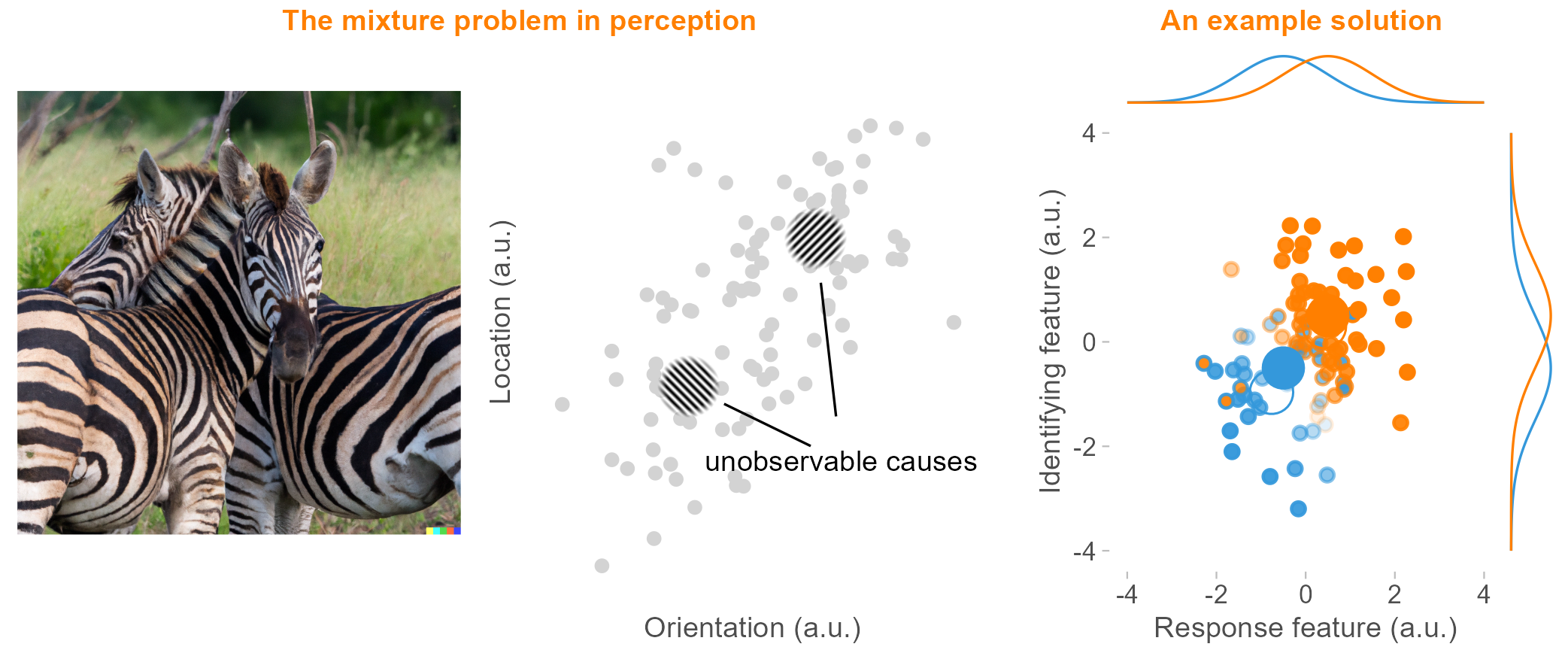
Many studies in perception and in the working memory literature demonstrate that human observers systematically deviate from the truth when estimating the features of one item in the presence of another. Such inter-item or contextual biases are well established but lack a coherent explanation at the computational level. Here, I propose a novel normative model showing that such biases exist for any observer striving for optimality when trying to infer the features of multiple similar objects from a mixture of sensory observations. The 'demixing' model predicts that bias strength and direction would vary as a function of the amount of sensory noise and the similarity between items. Crucially, these biases exist not because of the prior knowledge in any form, but simply because the biased solutions to this inference problem are more probable than unbiased ones, counter to the common intuition. The model makes novel predictions about the effect of discriminability along the dimension used to select the item to report (e.g., spatial location) and the relative amount of sensory noise. Although the model is consistent with previously reported data from human observers, more carefully controlled studies are needed for a stringent test of its predictions. The strongest point of the 'demixing' model, however, is that it shows that interitem biases are inevitable when observers lack perfect knowledge of which stimuli caused which sensory observations, which is, arguably, always the case.
Probabilistic representations as building blocks for higher-level vision
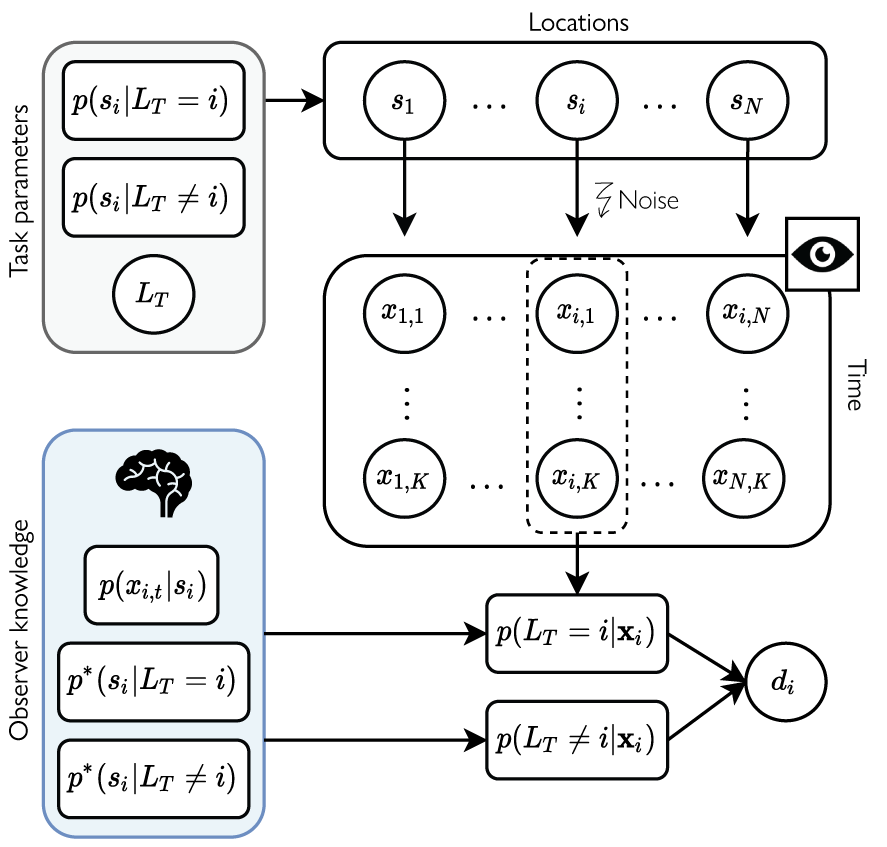
Current theories of perception suggest that the brain represents features of the world as probability distributions, but can such uncertain foundations provide the basis for everyday vision? Perceiving objects and scenes requires knowing not just how features (e.g., colors) are distributed but also where they are and which other features they are combined with. Using a Bayesian computational model, we recovered probabilistic representations used by human observers to search for odd stimuli among distractors. Importantly, we found that the brain integrates information between feature dimensions and spatial locations, leading to more precise representations compared to when information integration is not possible. We also uncovered representational asymmetries and biases, showing their spatial organization and explain how this structure argues against 'summary statistics' accounts of visual representations. Our results confirm that probabilistically encoded visual features are bound with other features and to particular locations, providing a powerful demonstration of how probabilistic representations can be a foundation for higher-level vision.
News
October 2026
- A new preprint by Talha Özüdoğru, Andrey Chetverikov, Richard Huskey, Leendert van Maanen, and Christoph Strauch: “Generalizable experiment agents threaten online behavioral experiments”. After Andrey’s skeptical reply earlier this year, he teamed up with the authors of the original commentary to test the question directly. An agent built entirely through natural-language prompting with a consumer LLM subscription completed 26 online behavioral experiments across seven hosting platforms, mostly with human-like performance.
September 2026
- Together with Vebjørn Ekroll, Melika Miralem, and Subhankar Karmakar, we spent two days at Forskningstorget during the Research Days in Bergen with a stand called “Can You Trust Your Eyes?”, showing visual illusions to children and their parents: spinning tops, 19th-century animation toys, a mesmerizing device made from an old record player, and lots of arts-and-crafts materials. Thunder, lightning, and rivers running through the tent did not spoil the fun. Andrey made an interactive illusions app for the event, and you can still play with it online (more in the LinkedIn post).
August 2026
- At ECVP 2026 in Bournemouth, Andrey presented a poster, “Too Much of the Same Thing: Overweighting Correlated Visual Evidence” (Chetverikov, Bailey, Ortega & Whitney).
- Also at ECVP 2026, Weronika Różycka presented her work from the lab in the poster “Bias in plain sight: Eye markers of contextual effects in visual working memory” (Różycka & Chetverikov) and received an ECVP 2026 Travel Award. Congratulations, Weronika!
July 2026
- Our preprint with Sabrina Hansmann-Roth, “Noise in Competing Representations Determines the Direction of Memory Biases”, is now a Reviewed Preprint in eLife, assessed as a valuable study of the mechanisms behind inter-item biases in visual working memory.
- Andrey served on the jury (examinateur) at Liubov Ardasheva’s PhD defense at Aix-Marseille Université, with the thesis “Perceiving and tracking ambiguous motion: the role of in-built priors, recent visual history, and sensory evidence”. Congratulations to Liubov on a successful defense!
May 2026
- At VSS 2026, the collaboration with David Whitney’s lab continued with the poster “Stable Correlations Bias Ensemble Perception” (Bailey, Ortega, Chetverikov & Whitney).
- Andrey gave a lecture with Mauro Manassi on “Eye movements analysis and pupillometry in visual working memory studies” at the Tracking Eyes and Mind workshop at UiB.
- Andrey served as opponent and evaluation committee member at Alan Voodla’s PhD defense, a joint degree of the University of Tartu and KU Leuven, with the thesis “Does it feel right? Towards an affective perspective on metacognitive confidence”. Congratulations to Alan on a successful defense!
- Alexa Cristea submitted her bachelor’s thesis, “AI attitudes and persuasion by AI-generated images”, supervised by Andrey. Congratulations, Alexa!
March 2026
- Weronika Różycka from SWPS University in Katowice joined the lab as an Erasmus exchange student. Welcome, Weronika!
- Andrey posted a response to a recent letter claiming there may already be bots in online behavioral and cognitive studies. The response argues that the evidence does not support that conclusion and, by the same logic, one might as well suspect bots among the undergraduates at Cardiff.
February 2026
- Andrey visited David Whitney’s lab at UC Berkeley to discuss ongoing collaboration and gave a CogNeuro area talk, “Demixing in Visual Working Memory: How Similarity and Noise Distort Recall”.
- A new paper led by Soha Farboud and colleagues in collaboration with Andrey Chetverikov appeared in Nature Communications: transcranial ultrasound stimulation of the frontal eye fields can rapidly shift choice behavior. Congratulations, Soha!
December 2025
- Ayberk Ozkirli, Andrey Chetverikov, and David Pascucci published a paper in Nature Human Behaviour. Using a large mega-analysis, they show that serial dependence — a kind of serial bias in perception — is not particularly beneficial for behavior, reducing perceptual accuracy. Congratulations, Ayberk!
- Andrey Chetverikov and Sabrina Hansmann-Roth posted a preprint on why items in memory sometimes are attracted and sometimes repelled by each other. They test Andrey’s Demixing Model predictions, pointing to competition between noisy representations as the main driver of biases.
November 2025
- Ekaterina Andriushchenko, Andrey Chetverikov, and Gianluca Campana published a paper in BMC Biology. The paper shows that attention doesn’t always lead to changes in serial biases, while prioritization of items in memory might have its own effects. Congratulations, Ekaterina!
- Árni Kristjánsson and Andrey Chetverikov published a commentary in Behavioral and Brain Sciences arguing that attention research is moving well and should not be boxed into one narrow framework.
October 2025
- Andrey gave an invited talk at Liverpool John Moores University (hosted by Nika Adamian).
- Andrey served as opponent at Lari Virtanen’s PhD defense at the University of Helsinki (supervised by Maria Olkkonen and Toni Saarela). Congratulations to Lari on a successful defense!
August 2025
- Andrey and Ekaterina visited the labs of Christoph Bledowski and Rosanne Rademaker in Frankfurt. Andrey gave invited talks at Goethe University’s Institute of Medical Psychology and at the Ernst Strüngmann Institute, focusing on visual working memory biases.
- At ECVP 2025 in Mainz, Andrey and Ekaterina presented the lab’s ongoing work on contextual bias and uncertainty in visual memory. In his talk “Biased Colors in Biased Space”, Andrey showed that biases in color and spatial memory are interconnected and depend on feature similarity across dimensions. Ekaterina’s poster, “Beyond the Noise: The Complex Interplay of Past and Present Uncertainty in Serial Dependence” (Andriushchenko, Hansmann-Roth, Campana & Chetverikov), showed that serial dependence is jointly shaped by uncertainty in both current and previous stimuli, supporting a multi-source uncertainty account.
- Also at ECVP 2025, the poster “Confounding effects of stimulus-specific biases on serial dependence” (Ozkirli, Chetverikov & Pascucci) was presented.
July 2025
- Work by a group of UiB students supervised by Andrey was published as a paper in Journal of Vision. The study replicates a key serial-bias finding and clarifies when attraction versus repulsion is most likely to appear. Congratulations to the students on their publication!
- Ekaterina joined the Neuromatch Computational Neuroscience Summer School to hone her skills and expand the lab’s computational toolkit.